Tuesday, October 27, 2009

Week 7: Classes

Leigh, Rae, Rachel


One of the highlights on week 7 was hearing Graham Hopwood from the NGO Institute for Public Policy Research (IPPR) spoke to our political science class. The IPPR is working to inform political and community debates, partially through an online site similar to those created in the USA during our recent elections. However, very few people in Namibia have reliable access to computers, which makes internet outreach seem ineffectual. He acknowledged that access to technology is a large problem and does impact voter education and outreach, but feels that small outreach is better than none.


An important unknown in the upcoming elections is the vote of the “born frees.” The generation born right before and during independence has the option to vote for SWAPO because their parents did, not to vote at all, or to critically vote for a party after forming their own political opinions. The three of us feel that voting is extremely important, and that it is the key to creating change and promoting democracy. Criticallyassessing the promises of the political parties is part of every citizen’s active duty and we feel that Graham’s organization, by advocating voter education is increasing people’s capacity to think critically about the government and create positive changes.


The religion class visited a pastor at the Dutch Reform Church. The pastor discussed the difficulties that the church faces today due to its former role in supporting Apartheid for so many years. The class was very interested in hearing this perspective because we have only heard negative opinions regarding this religious institution based on its role in apartheid. The history of the church that he presented to us was interesting because we were able to understand how church ideology can change with the times. He explained that the ideology changed by supporting the institutionalized separation, to the church supporting the oppressed like G-d and Jesus have always done. The church is embracing these changes, but there is still a difficult stigma to overcome with the local population. Our opinion in general is that the church was right for changing its ideology, but it should have never supported the Apartheid in the first place. Our class has been asking a lot of questions about the influence of church and state, and found it very interesting that the church did not speak out against Apartheid earlier due to political repercussions and consequences.


In history class, we compared Namibian and American racial histories and current realities. Dr. Christo Botha, an Afrikaaner professor at the University of Namibia, explained that apartheid was based partially on fear of black domination and also on cultural purity. A classmate stated that Apartheid seems good in theory but impossible in action. Preservation of culture is important, but many of us do not feel that institutionalized segregation can preserve culture. If the idea was to maintain cultural purity, so me of us questioned why the whites were not separated like the blacks were. The whites in South Africa were made up of Afrikaners and British, but they were not divided by ethnicity while the black people were divided were. We felt although racism in both countries is still prevalent, it is more openly acknowledged in Namibia,

while the US mentality

is that racism ended with the civil rights movement. Based on a class discussion that included individual’s experiences with racism in both Namibia and The States, the overwhelming anecdotal evidence was that Americans are much more politically correct with their racism or secretive, whereas people have encountered much more open racism in Namibia.


After working the prior week on a 5 to

7 page paper on globalization’s impact in Namibia and handing it in, the development class visited the USAID office and learned about the different jobs within USAID, the USAID relationship with the Namibian government, the current American foreign policies, and USAID programs. Some students thought USAID’s approach had no emotional connection to its aid recipients since it is a large-scale organization that dispenses aid to umbrella organizations, which then channel the money to its member grassroots organizations. Other students didn’t mind the “impersonal” approach that USAID takes, and could work for USAID as long as they knew they were helping others. Rachel feels that to make the most positive impact there must be personal involvement from the grassroots, and that while the money being distributed at the top may be helpful, the most effective change can be made on the ground. She also respects USAID for the positive programs it funds but feels that she could never work there.


We all agreed that the different paths each employee that spoke to us had taken were encouraging to hear, since some of us are interested in doing foreign aid work as an occupation Some of the class’ criticisms were that those who work there are forced to adhere to government policies that may not be the best policies for the situations at hand. For example during the Bush administration they were forced to teach abstinence instead of condom usage. However, most of us feel that abstinence will not help or protect prostitutes for example.

Week 6: Classes and the Coast

Catherine Raleigh, David Beck, Hannah Lee

Week six has been a busy week! We had a short week of classes followed by a long weekend on the coast. The highlights of our Political Science and Religion classes this week included a discussion regarding the Namibian Constitution, a trip to Parliament, and a lecture about the spread of Christianity throughout Southern Africa. Mr. Samson Ndeikwila[1] informed us about the creation and adoption of the Namibian Constitution. He explained that the Constitution is very progressive in regards to human and civil rights. However, it is difficult to amend and not understood by all Namibians because it has not been widely distributed in local languages and education in regards to its contents is limited. In Religion class, we discussed the pros and cons of the spread of Christianity to Namibia and its relation to traditional African religions. We (David and Hannah) have found the influence of Christianity in Namibia to be very interesting and multifaceted; Christianity has been used as a tool of oppression by colonial powers, as well as a force for mobilization during the liberation struggle, as well as today.

And then it was on to the coast! In meeting with the Walvis Bay Municipality, we learnt about the crucial role this port town plays in Namibia’s economic development. Walvis Bay is critical to the fishing industry, the movement of imports and exports, the tourism industry, as well as the mining industry. At the same time, Walvis Bay has 36% unemployment, while many of the companies that have invested in the area are foreign-owned[2]. We found it astonishing that the unemployment rate in the area was so high, as Walvis Bay has one of the strongest economies in the country, so we look forward to comparing it to other areas we will travel to later in the semester. This presents an example of the complexities surrounding economic development in Southern Africa, as well as around the world. We found it interesting that there was such a high concentration of foreign-owned companies in the area, for example the Mascato Fish Processing Company that we toured, which was Spanish-owned and sold to the Spanish economy.

Pertinent to the discussion about foreign investment was our trip to a factory that belongs to the Export Processing Zone (EPZ). One of the complexities in regards to EPZs, which we have talked about in class, is that attracting foreign investment is seemly beneficial to national economic development, but at the same time, most of the profit from the local operations leaves the country. We have found that this foreign investment and the presence of the EPZ is an example of the influence on globalization on Namibia, which has been a frequent topic of class discussion. It is also a topic that we have yet to reconcile, because while these economic activities seemingly stimulate development, we are unsure how sustainable and beneficial they are in the long term.

Another part of our time on the coast included a tour of Mondesa, one of Swakupmund’s former townships. This enabled us to see another side to an area that is simply assumed to be a tourist attraction by many, but which actually houses much of the local population. While apartheid has ended in Namibia, it is striking how it remains that areas of poverty are so separate from more popular tourist sections of town. We were glad to be able this area of Swakopmund, because it is far too easy bypass them for more affluent environments.

One of the highlights of this tour included a visit to Mondesa Youth Opportunities (MYO), an organization that takes gifted students from the area to further their education and provide opportunities which they may not have had access to otherwise. We also got to meet with Lindsay Hoover, a former CGE student now working with MYO.

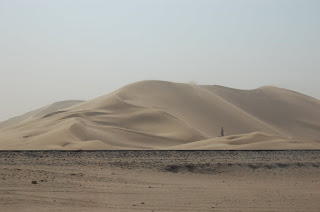
This concluded our academic portion of the trip, but our time at the coast was also filled with climbing Dune 7, sea kayaking, skydiving, sandboarding and paragliding on our free day. While we enjoyed these “tourist” activities, we appreciated being able to see a more complex side of Swakopmund and Walvis Bay.


[1] Ndeilkwila, Samson, “Forum for the Future,” class discussion on September 22nd, 2009 in Windhoek, Namibia.

[2] Marques, Nouto, with the Walvis Bay Municipality, presentation on September 24th, 2009 in Walvis Bay, Namibia.

Week 5: Legacies of Colonialism

Rachel, Allison, Anna

The legacies of colonialism and apartheid still shape much of Namibian culture and society. This week we examined this from a variety of perspectives. On Monday, we continued our internships and volunteering. Rachel, working as an intern at Friendly Haven, was struck by how closely domestic abuse and poverty are related. Anna also came to the realization that feelings of helplessness are perpetuated by ensconced racial and economic barriers, which manifest themselves in poverty. This is one of the direct causes of gender based violence and child abuse in Namibia. Even after their conclusion, colonialism and apartheid left people--in particular adult males--hopeless. It is easy to view this situation as one sided especially when you are presented with the innocent victims. These are amazing women and children who are caught in a virtually inescapable situation. But this is not a black and white issue. The prevalence of the violence makes it clear that it is at least in part a result of a system of oppression, and it will not be fixed until the system is ultimately overhauled.

Tuesday’s Political Science class focused on the idea that the poor education of the indigenous people was an intentional creation of the colonial powers. The Bantu education system used language barriers to create a class of servants rather than scholars. Our speaker for this class, Mr. Elia Manga, the deputy director of the Ministry of Education, talked about what the current inadequacies are (early dropout and failure rates, school fees, inefficient allocation of funds) and what improvements are being attempted. Specifically, he told us about an online school that dropouts can use to try to continue their education. Although Apartheid has ended in name, its legacy continues to separate people based on class and race. Until there is a system in which all Namibians have equal access to education and opportunity, the system of separation and resentment will not end. It is crucial to be aware of the inequalities, and to address them directly. Pretending that the educational system is adequate will never fix the problems within it, and believing that all Namibians are equally protected under law will mean that the inequalities will never be addressed. We, in conjunction with Namibians, need to speak up about the injustices that we have been privileged enough to be educated about.

The written history of the colonial period has left many Namibians and foreigners with the impression that pre-colonial Africa was a godless society. Though Europeans brought Christianity to Africa, it was readily embraced by the indigenous societies in part because it resembled traditional religions. Our Religion speaker, the Reverend Kristoph, emphasized the fact that nearly all pre-colonial societies had a concept of a supreme being that Christians would call God. We did, however, spend much of the class discussing whether or not comparing the traditional religions to Christianity detracted from the religions in their own right. We came to the conclusion that while the colonial imposition of Christianity might have been problematic, it does not give us the right to question the faith of modern Africans. They best understand their own religions, and we must trust their opinions above all in a consideration of the overlap between indigenous religions and Christianity. Africans may have been coerced into Christianity at one point, but now it belongs to them, and they have adapted as well as integrated it.

In History class on Thursday, we listened to Uncle Paul discuss the role he played in the liberation struggle as a member of SWAPO. We had another speaker from Breaking the Wall of Silence who chronicled her tale of torture by the SWAPO party. Many students walked away from the class with troubled and conflicting ideas about how SWAPO influenced the liberation struggle. Though SWAPO's influence was instrumental in gaining liberation for thousands of people, they did so at the price of human rights for many others. In this case the question becomes do the means justify the ends? What are we willing to give up for freedom? Is freedom really just another word for nothing left to lose?

Development class on Friday finally put a more positive spin on the week. We went to the Basic Income Grant office to learn more about the grant and what it has done for the test village in which it was implemented. Overall, the BIG seems to have been effective at helping to alleviate poverty In the test village, Omitara/Otjibero, the program has been running since January 2008. The changes in the town have been immense. Malnutrition among children has decreased, independent businesses have started up, and drop-out rates have greatly declined. The BIG is an effective way to alleviate poverty and allows for a completely reasonable amount of redistribution of income. We then discussed how the concepts of economic-dominated minorities apply in Southern Africa. These groups represent a very small sector of the population but control a large majority of the economic resources. Despite the popularly elected government, the descendants of colonists still control the vast majority of the economy and means of production. This leads to continuing racial barriers and separation. It is hard for us to understand Namibian whites are not doing more to aid the economy. For example, Rachel was shocked to hear rich Namibians claiming that they were not interested in the BIG, because they were unwilling to sacrifice any of their privilege for the basic needs of others.

Monday, September 21, 2009

Week 4: Classes and Urban Homestays

By: RuthAnn, Jessica, Rae, and Alex!

During our fourth week, academic reality set it as we had our first full week of classes and began learning the language of Damara from Baby, a former Peace Corps language teacher. We will be staying with a rural family later who speaks Damara. In addition to dealing with the stress of classes and homework, we began our 10-day urban homestay. This homestay was more difficult than the homestay in Soweto because we were flying solo in a foreign culture and didn’t have another student for support. We concluded that there is no one “Namibian family”; tribe, race, and language played a major difference in the family makeup. For example, some students lived with Damaras while others lived with Ovambos. Some students had a distinct advantage by practicing Damara with their host families. Other students lived in the historically “colored” area of Khomasdal, while other students lived in the “black” township of Katutura. During our homestays, we were introduced to English-dubbed Spanish telenovelas, referred to as “Soapies”. Most students quickly developed favorite characters from the two most popular shows, “Lorenzo’s Wife” and “Storm over Paradise.”

In Development class, Herbert Jauch from the Labor Resource and Research Institution spoke about development in Namibia and the vast level of inequalities that make Namibia number one on the GINI scale. He promoted a Basic Income Grant (BIG) to jumpstart the process of narrowing inequality by giving each Namibian 100 dollars a month from birth until the age of 65 when individuals would qualify for their pension. We can see more than one side to this proposal: some students think that it is a wonderful idea and would benefit those poor Namibians, while others are more concerned about the potential problems in restructuring the taxation system. He also proposed fair land distribution, pointing to Zimbabwe as an example of what happens due in part to unresolved land issues.

We visited the Alte Feste Museum, a former German fort with information about rock drawings, the liberation struggle, and colonialism. Later in history class, we watched a BBC movie on the Herero genocide of 1904 and found out that the museum we had visited earlier was in fact a concentration camp for the Herero people. The students were dumbfounded that our tour guide did not mention that the fort was a concentration camp; we assumed that information would be a key part of museum presentation. We feel this example underscores the idea that history is selectively created from events strung together based on a certain perspective. A speaker in the BBC movie, Professor Kerina, the first Namibian UN representative, came to our class to speak about the liberation struggle and the challenges following independence. Saying, “only dogs and slaves are named by their masters. Free men name themselves,” Kerina emphasized the need for a country to choose its name.

Friday, September 18, 2009

Week 3: Classes

Catherine Mullin, Leigh Isaacson, Lizzie Cohen

This was our first full week in Windhoek so it was action packed to say the least. The main events of the week included starting our internships, a team building retreat, the beginning of classes, along with the start of our urban homestays.

All students doing internships started bright and early Monday, September 1st. The internships range from NGO’s like the Namibia Development Foundation to Women’s Solidarity. Though most students had a slow first day, and felt that often things at the organizations were done on “Africa time”, all emerged feeling hopeful about the situation at their organization.

Tuesday was all about team building activities at a ranch outside the city center. It was a long day, but we all enjoyed ourselves and learned a lot about our fellow students and the staff here at CGE. Activities included creating a yarn web and two egg races. The rest of the day was designated for us to present our “road maps”. The road maps were designed to explain how each of us came to be who we are today and some of the main events in our life. It is clear we have a really diverse group, with people coming from all different backgrounds, but we all are united by our desire to learn and experience new things during our time in southern Africa.

Classes kicked off this week with a look at some Namibian pre-colonial history with Romanus on Thursday. The class, which includes the majority of students on the program, traveled to the National Museum of Namibia. We were able to see traditional clothing, food preparation and geographical areas of the different tribes in Namibia. We also got a sneak preview to what our rural homestay might look like at one of the exhibits on typical housing for the different tribes.
Thursday night marked the beginning of our 10- day urban homestay. Nervous and excited, we were picked up by our host families and we spent the weekend living life like a typical Namibian. With the longer duration of this homestay students were immediately accepted as part of the family and were exposed to opinions on apartheid and the current political situation.

The school week ended on Friday, with Linda’s development class. The first class we discussed the meaning of development and the proper terms associated with describing different states and levels of development. Some students were distraught over the use of terms “developed”/ “developing” because of what each word implies about a country’s status and a long debate pursued. With the different backgrounds on development students brought to the class some were offended by the implications of the terms. It is clear that we are a diverse group and that we’re not afraid to share our opinions.

We also started our Damara language class, taught by Baby Doeseb. For most students this experience was out of their comfort zone and we all need some serious practice to get those “clicks” down before our rural homestays!

Friday, September 4, 2009

Week 2: South Africa and the Great Beyond

Ken, Margaret, Carlee

After a weekend homestay in Soweto our group travelled to Pretoria on August 24. First we visited the US Embassy and talked to Foreign Service Officer Jonathan Smallridge. Since we had heard a variety of South African perspectives, hearing both US foreign policy and the official US stance on South African politics broadened our perspective and educational experience. Particularly interesting was his statement that “South Africa is seen as the pillar of Africa” since all of our previous speakers and activities focused on the challenges that South Africa faced. Those of us considering a career in Foreign Service also enjoyed Mr. Smallridge’s advice and stories about becoming a member of the US bureaucracy.

Our trip to the Voortrekker Monument on Tuesday, August 25th proved to be a contrast to the two museums that we visited in Johannesburg. Those (the Hector Pieterson Museum and the Apartheid Museum) focused on apartheid and, as such, placed the Afrikaners in a vilified position. While some members of our group (Ken) found the museum to be racially biased and imperialistic, others (Margaret) thought that it provided an interesting counterpoint to the first two museums. Ultimately, the juxtaposition of the three museums provided yet another example of a theme of the semester: a need to consider sources and avoid immediate judgment.

Later in the afternoon, we went to the University of Pretoria and heard from Professor Jackie Grobler on the subject of Afrikaner identity. Carlee thought that Grobler displayed an obvious bias. Margaret and Ken found his presentation and response to the group’s rather pointed questions to be quite impressive. He did not attempt to justify apartheid, but rather explained his own personal experience and observations during the apartheid era. By avoiding both denial and apology, he offered an Afrikaner perspective that seemed realistic, regardless of the listener’s personal opinion.

After our flight to Windhoek on Wednesday, August 26th and our introduction to the CGE house (which all three of us love!!!) we took a tour of the city on Thursday. There we learned about the history of apartheid in Namibia and about the current situation in the informal settlements. We were able to compare and contrast the settlements in Kliptown, South Africa with the settlements in Katatura, Namibia. The Namibian settlements appeared to have a much higher level of service provision than the South African settlements, but that difference may have been caused by the attitudes of our tour guides. In Kliptown, we were led through the streets by local residents who advocated against privatization; in Katatura, we looked down on the settlements from a nearby hill with professional tour guides.

We are looking forward to exploring more of the politics and history of Namibia in our classes and in our daily activities, so that we can understand whether the differences we observed were a matter of perspective or of tangible change and improvement. On Friday, we went to various political and social organizations in Katatura with local students as our guides. Saturday and Sunday we had free time and got to go out and explore the city and its nightlife, as well as having some much needed down time to prepare for our internships, scheduled to start on Monday, August 31. A highlight of the week was hearing local bands perform in a festival at Zoo Park on Saturday and we are looking forward to the remainder of our semester!

Wednesday, September 2, 2009

Week 1: Welcome to Johannesburg!


The first week of the program was a whirl-wind full of visits to surrounding communities, lectures, museums and cultural experiences.

Monday morning, still jet lagged, we began our adventures with a brief history of apartheid and the liberation struggle in South Africa. Mr. Molefi Mataboge provided background for a two-day tour of Soweto that would follow. During our tour of Soweto (South Western Township) we were able to see various informal settlements within the community, where citizens have built many tin shacks. Views of poverty and lingering oppression quickly became evident and many questions were formed within the group: Why does it seem that the government has not done much to improve the lives of its people after apartheid? What legislation has been put into place to improve the quality of life? How can people live in the conditions of poverty and oppression?

Throughout the rest of the week we gained a better understanding of the events that have affected the people of Soweto with visits to the Regina Mundi church (a place that played an integral role in the fight against apartheid), the Hector Peterson museum (a commemoration of the student uprising against the use of Afrikaans as a medium of instruction in schools), a semi-private school (where we were able to communicate with students about their experiences in Soweto), and the Apartheid museum (which gave us a better understanding of the history and events of apartheid).

In between visits to the different locations we met with a variety of speakers and organizations, including the Anti-Privatization Forum (APF), the South African Council of Churches (SACC), and the Treatment Action Campaign (TAC)—who addressed issues, current events, and their perspectives concerning the future of South Africa.

One of our favorite lectures were with members of the TAC, who informed us about their organization and their efforts to combat HIV/ AIDS in South Africa. The organization works with health and human rights issues, providing education and resources to the public. Tristen Taylor, an environmentalist, talked to us about the economy of South Africa, providing insight into the economic future of the country. He explained how the end of apartheid was “political freedom, but not economic freedom” for the people, and that [apartheid] has remaining implications on the current economy and the future. Taylor provided a vision for what the year 2020 may look like, suggesting that the prices of basic resources (like oil and water) will have detrimental affects on not only the people of South Africa.

We also explored the political climate with Mr. Michael, a member of the African National Congress (ANC), who discussed his involvement in the political party and its original platform. In addition we met with the current opposition party of the ANC, the Democratic Alliance (DA), to discuss their political views. Both political parties shared similar views on many issues facing South Africa—housing, education, privatization of utilities, HIV/AIDS, etc.—however, their methods of attainment differed.

At the end of the week we departed in pairs for our homestays in Soweto for the weekend. This experience allowed us to expand upon what we had learned over the course of the week through the lens of a South African family. During our homestays we were encouraged to become part of the family, participating in daily activities (cooking, cleaning, running errands, family outings, etc.) The time spent with these families provided a new perspective on the lives of those living in Soweto today. Some students experienced the traditional food (chicken feet, fat cakes, pop), funerals, parties, church services, and braais (BBQ’s).

This week has been an adjustment for all of us—getting to know each other and the country. We have been thrown out of our comfort zones and have confronted questions concerning our observations and experiences. We have wrestled with ideas surrounding race, gender, privilege, economic status, and political ideology. Through this we have gained a better understanding of the history and struggles of South Africa, providing a basic framework for our upcoming classes and experiences during the semester.

Captions:

1. Members of the Fall 2009 Crew met up to board the plane to Johannesburg in the Washington Dulles Airport.
2. The Regina Mundi Church, a place where citizens of Soweto gathered during apartheid, and was a hotspot for police activity.
3. A view overlooking Kliptown, a part of Soweto that has remained extremely impoverished even after the end of apartheid.